What people use a tone generator for
The classic jobs are testing and tinnitus matching. For testing, a steady sine at a known frequency probes one thing at a time: 1 kHz for general response, 60 Hz for bass reach, 10 kHz and up for treble. Musicians use 440 Hz as a tuning reference. For hearing checks, slowly raising the frequency while you listen alone tells you roughly where your high-frequency hearing ends — most adults lose the top octave gradually. All of these need nothing more than the slider above.
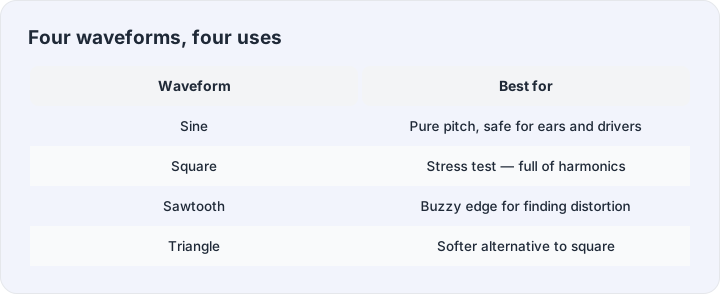
The four waveforms matter more than they look. Sine is a single pure frequency — safe, smooth, and what you want for almost everything. Square and sawtooth are rich in harmonics, which makes them excellent stress tests: if a speaker survives a loud square wave, it survives anything. Triangle sits between. If a tone sounds harsh on square, that is the harmonics, not a fault.
Sweep and export
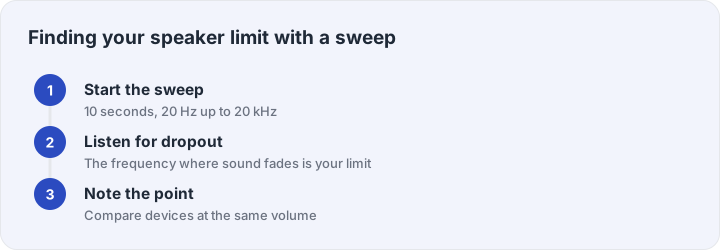
The sweep button glides from 20 Hz to 20 kHz over ten seconds — the fastest way to find a system’s weak spots, because resonances and dropouts reveal themselves as the pitch passes through them. Note roughly where the sound thins out, then use the frequency slider to park on that spot and investigate. The download button renders the current tone as a three-second WAV file, handy for plugin testing, camera audio checks or any app that needs a local audio file.
Your last waveform, frequency and volume are remembered on this device, and the current frequency lives in the page address — bookmark or share the link and it opens with the same tone ready.