Home›Bass Test
20–120 Hz · one tap per tone

Bass Test — how low does your speaker really go?

Step through seven bass frequencies from 20 Hz to 120 Hz and hear exactly where your speakers run out of honesty.

Tap a frequency — each tone plays about 2 seconds. Start around 40 Hz and work outward.

Use a moderate volume: very low tones at high volume can distort small speakers — distortion here is your equipment, not the test file.

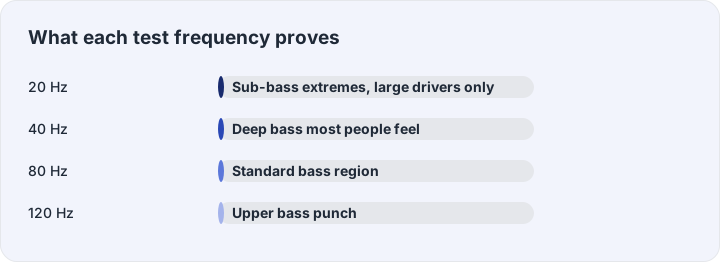
Bar chart: what each test frequency proves

What a bass test tells you

Bass is where speakers lie the most. A small driver can fake the higher bass notes by playing their harmonics, but below roughly 60 Hz there is nowhere to hide: either the driver moves enough air or it does not. Stepping through the seven tones here maps your equipment’s real floor. On a laptop you will typically lose everything below 80 Hz; on a phone loudspeaker, below 200 Hz — which is why the 20 and 30 Hz buttons sound like silence with a faint flutter on most phones. That is not a broken file; it is physics.

On headphones the opposite applies: even budget in-ears reproduce 20 Hz as pure tone, because sealing a tiny driver against your ear canal is acoustically easier than moving air across a room. If 40 Hz sounds weak on headphones, re-seat the earcups or tips — seal lost is bass lost — before you blame the hardware.
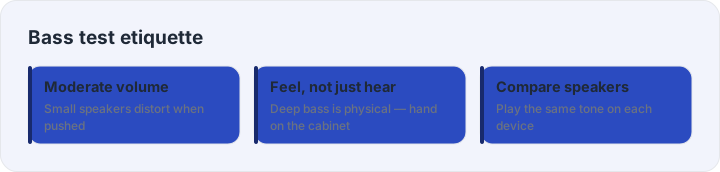
Grid: moderate volume, feel the cabinet, compare devices

How to listen

Set volume to a moderate level first — deep tones carry real energy, and pushing a small speaker to play 30 Hz at high volume produces distortion that can sound like rattling failure. Start at 40 Hz and work outward in both directions. Below your equipment’s limit you will hear the tone fade into either silence or a buzzy, strained noise; the transition point is your honest floor. Put a hand lightly on a speaker cabinet during 20–40 Hz: deep bass is physical, and feeling the panel move counts as reproduction even when your ears give up before your fingertips do.

Use the same seven tones to compare equipment fairly: play each tone at the same volume setting on your laptop, phone and headphones, and you will hear exactly what you are paying for when a spec sheet says “extends to 20 Hz”. When you find a speaker that plays a tone but adds buzz, the crackling fix guide explains the usual mechanical causes.

Frequently asked questions

Why can I not hear the 20 Hz tone?

Human hearing fades below about 20 Hz, and most small speakers cannot reproduce it at all — silence or a faint flutter at 20–30 Hz is normal on laptops and phones. Full-range speakers or good headphones will render it as deep tone.

Is it safe to play loud bass through my speakers?

Moderate volume is fine. Very low frequencies at high volume push drivers past their travel limits and can mechanically damage small speakers — keep the volume sane during 20–40 Hz tests.

My speaker buzzes on low tones — is it broken?

A buzz means something loose or a driver pushed past its limit. Lower the volume and retest: if the buzz disappears, it was overload; if it persists at low volume, something in the enclosure or suspension is loose — see the crackling fix guide.

Do headphones have better bass than speakers?

Usually yes at the same price: a sealed earcup or tip only has to pressurize your ear canal, while a speaker must move air across the whole room. That is why 20 Hz on cheap earbuds can out-bass a big Bluetooth speaker.

What volume should I use for this test?

Around half to two-thirds of your normal listening volume. Loud enough to hear the low tones, low enough that small drivers do not distort — you are mapping a limit, not testing endurance.